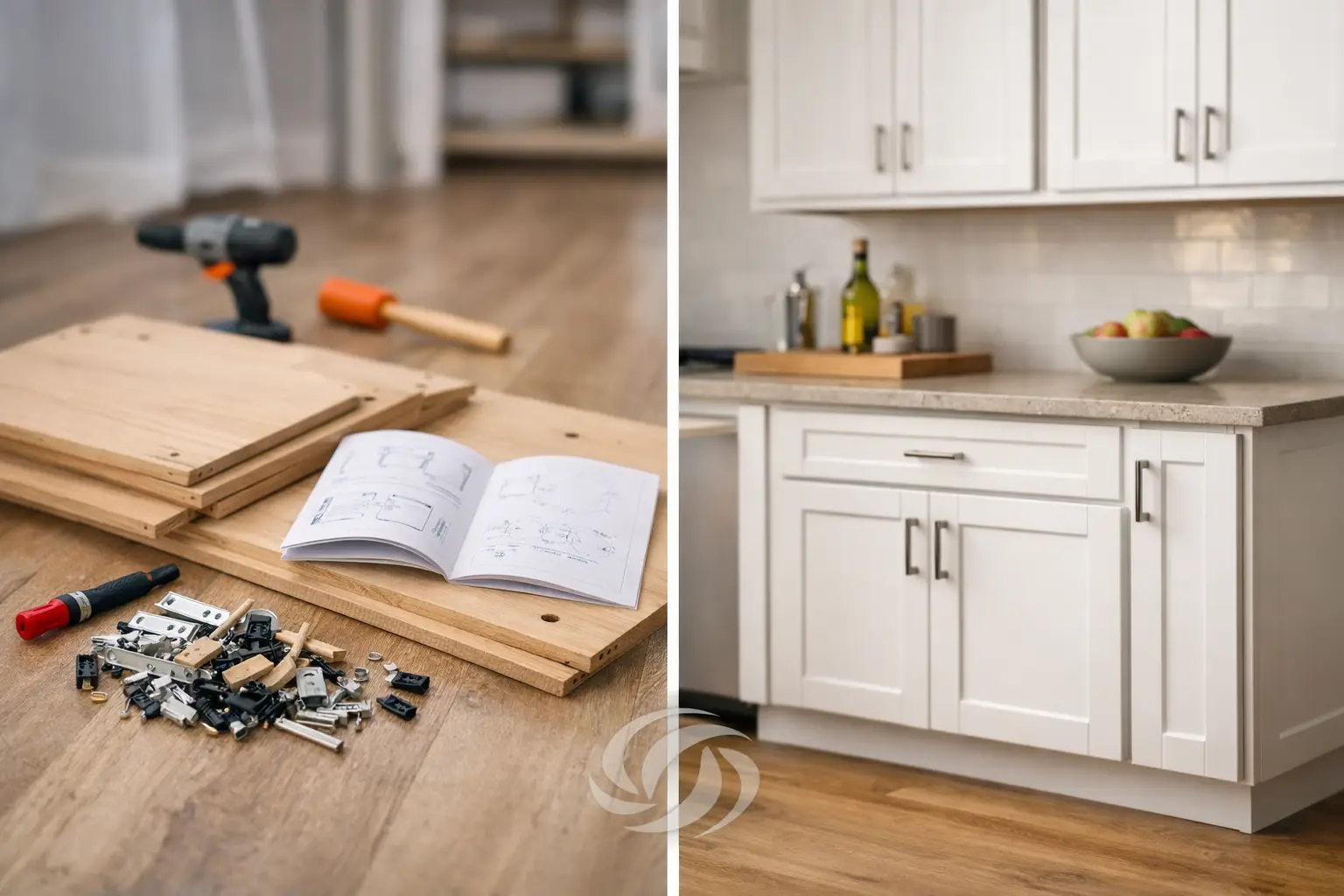
A cabinet quote can look attractive until the boxes arrive flat-packed and the real work begins. When comparing ready-to-assemble versus assembled cabinets, the purchase price matters, but so do the hours required for assembly, the accuracy of the installation, the materials behind the finish, and how the cabinets will hold up through years of daily use.
For a small project with a tight budget, ready-to-assemble cabinets can be a sensible route. For homeowners planning a full kitchen renovation, pre-assembled cabinets often bring greater confidence, better fit, and fewer opportunities for costly delays. The right choice depends on your project scope, your timeline, and how much of the work you want to manage yourself.
What ready-to-assemble cabinets are designed to do
Ready-to-assemble, often called RTA, cabinets are shipped in separate panels, doors, drawers, hardware, and instruction packages. The buyer or installer assembles each cabinet box before it can be set, leveled, fastened to the wall, and finished with doors, drawers, toe kicks, and trim.
Their main appeal is straightforward: flat-packed components generally cost less to ship and store than completed cabinet boxes. RTA cabinets can work well for a rental refresh, a utility room, a basement bar, or a homeowner who is comfortable measuring carefully and completing detailed assembly work.
That lower upfront price should be reviewed in context. A kitchen may require 15 to 30 cabinet boxes, each with its own assembly steps. If the project needs paid labor, additional tools, replacement hardware, or adjustments for pieces that do not go together squarely, the savings can shrink quickly.
Where RTA cabinets can make sense
RTA cabinets are often practical when the layout is simple and the room has standard dimensions. A homeowner who has experience with cabinetry, owns the right tools, and has time to work methodically may find them a good value. They can also be useful when a project is not dependent on a precise delivery and installation date.
The key is to assess the cabinet construction before focusing on the door color. Some RTA lines use thin particleboard, cam-lock fasteners, and limited drawer hardware. Others offer stronger materials and better joinery. These are not equivalent products, even if both are described as ready to assemble.
How assembled cabinets change the renovation process
Assembled cabinets arrive as completed, factory-built boxes. The cabinet sides, backs, bottoms, and frames are already joined, and doors and drawers are typically fitted before delivery. This reduces the amount of field work required and allows the installation team to focus on what matters most: accurate layout, secure fastening, level cabinet runs, aligned doors, and clean finishing details.
For a busy household, this difference is significant. Rather than turning part of the home into an assembly area, you receive cabinet boxes that are ready for careful placement. It also makes it easier to identify any shipping or production concerns before installation begins.
Pre-assembled cabinetry is especially valuable in kitchens with several corners, tall pantry cabinets, islands, integrated appliances, or custom storage features. These projects have many points where small measurement errors can affect the final result. A cabinet that is slightly out of square can create visible gaps at the countertop, uneven drawer reveals, or door alignment problems that take time to correct.
Quality is more than whether the cabinet arrives assembled
Assembly method is only one part of cabinet quality. A well-built cabinet should use materials and hardware that suit the demands of a kitchen. Solid plywood construction provides a stable, durable cabinet box and holds fasteners well. Premium finishes help cabinets resist the daily marks, moisture, and cleaning that come with family life. Soft-close hinges and drawer slides improve the feel of the kitchen while reducing wear from doors and drawers being shut repeatedly.
A pre-assembled cabinet made from weak materials is not automatically a better investment than a carefully chosen RTA cabinet. However, when strong plywood boxes, quality hardware, precise factory assembly, and professional installation are combined, homeowners get a more dependable result with fewer unknowns.
Ready-to-assemble versus assembled cabinets: the true cost comparison
The cabinet price is only one line in the project budget. To compare options fairly, consider the complete cost of getting from delivery day to a finished, functional kitchen.
With RTA cabinets, your budget may need to include assembly labor, tools, adhesives or fasteners where required, disposal of packaging, and time for adjustments. If you hire an installer, ask whether their price includes box assembly or whether that work is billed separately. Delays can also affect countertop scheduling, since countertops are measured after base cabinets are installed and leveled.
Assembled cabinets may carry a higher initial price, but they can reduce labor on site and create a more predictable installation schedule. That predictability is often valuable during a full renovation, when flooring, electrical work, plumbing, countertops, backsplash installation, and appliance delivery all need to happen in the right order.
For commercial spaces, multi-unit properties, and rental turnovers, the timeline can be just as important as the cabinet cost. A delay in assembly or a missing part can keep a unit out of service longer than expected. Completed cabinet boxes help simplify coordination and reduce disruption.
Installation accuracy affects the finished look
Even excellent cabinets will not perform or look their best if they are installed poorly. Walls and floors are rarely perfectly straight or level, particularly in older homes. Professional installation accounts for these conditions through precise shimming, fastening, scribing, and adjustment.
Cabinet boxes must be level enough for drawers to operate smoothly and doors to sit evenly. They must also be securely anchored to support dishes, small appliances, and heavy countertop materials. The installer needs to confirm clearances for appliance doors, plumbing connections, electrical outlets, and ventilation before the final pieces are in place.
This is where a full-service cabinet provider can make the process easier. Design planning, cabinet production, delivery, installation, final adjustments, and warranty support are connected rather than split among several suppliers and trades. If a question comes up, there is a clear point of contact and a clear next step.
Choose based on your project, not just the price tag
If you are updating a secondary space, have practical assembly experience, and can accept a more hands-on process, RTA cabinets may be worth considering. Take time to verify the box material, drawer construction, hardware quality, available sizes, and replacement-part process before ordering.
If your kitchen is the center of daily household activity, has an irregular layout, or needs to be completed on a defined schedule, assembled cabinets are usually the more practical choice. They support faster installation, more consistent alignment, and a cleaner route to the countertop and finishing stages.
Custom or semi-custom pre-assembled cabinets are also a stronger fit when storage is a priority. Deep drawers, pantry pullouts, corner solutions, waste and recycling systems, and cabinet configurations built around your cooking habits can make a kitchen feel larger and work harder without increasing its footprint.
Questions to ask before committing
Before choosing either option, ask what the cabinet box is made of, how the drawers are constructed, and which hinges and slides are included. Confirm whether the quoted price includes delivery, assembly, installation, trim, hardware, and final door adjustments. You should also ask how issues are handled after installation and what warranty coverage applies.
For homeowners in Winnipeg planning a kitchen renovation, a design consultation can clarify these details before orders are placed. At Emcab Kitchens, the goal is to match cabinetry, storage, finishes, and installation planning to the room and the budget, with clear timelines and no surprises.
The best cabinet decision is the one that leaves you with a kitchen that fits your routines, supports your storage needs, and still feels solid every time you open a drawer years from now.