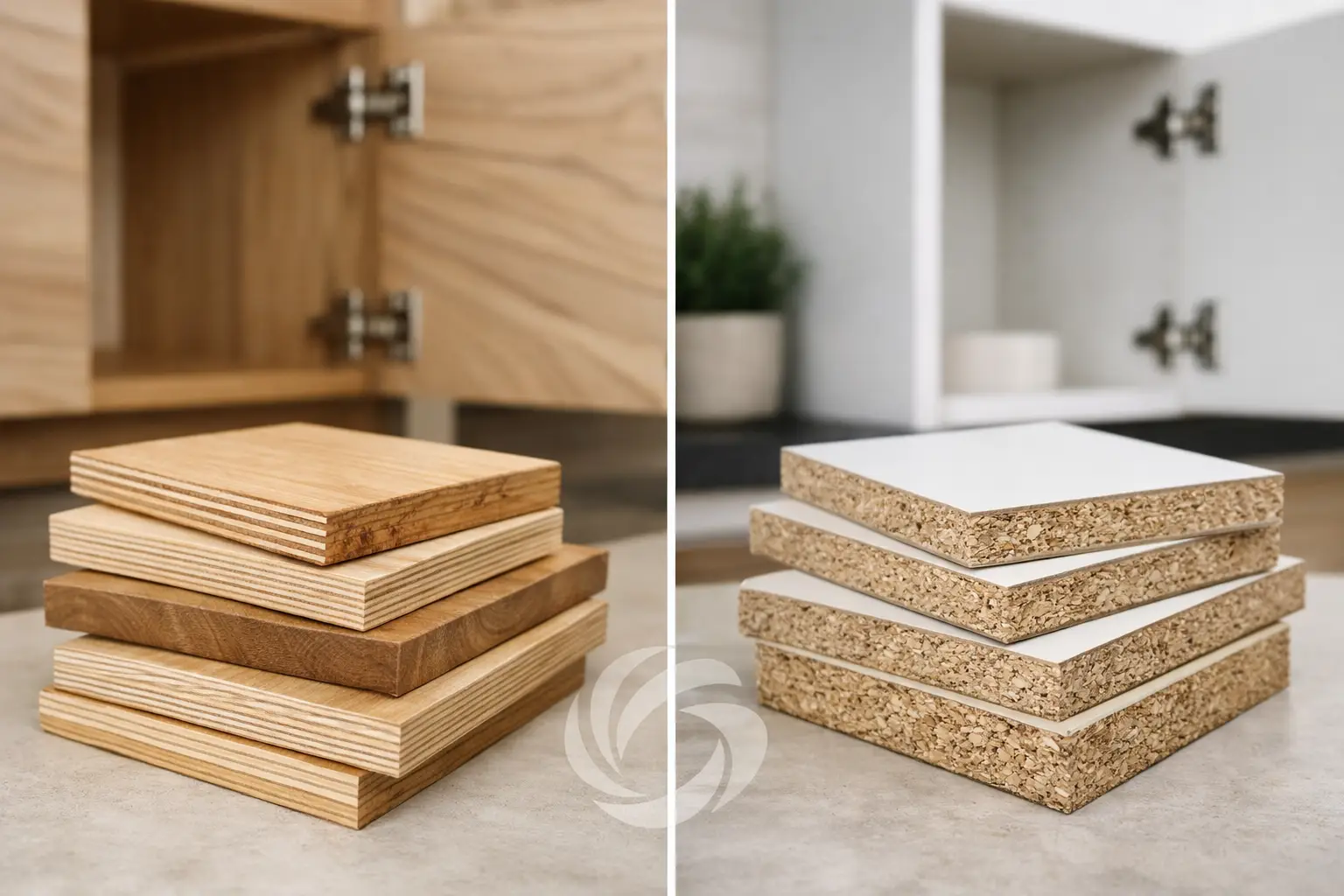
A cabinet door can look beautiful in a showroom while the box behind it tells a very different story. When comparing plywood versus particleboard cabinets, the real question is not which material has the better sales pitch. It is which cabinet construction makes sense for your kitchen, your budget, and the years of daily use ahead.
Cabinet boxes carry the weight of dishes, small appliances, pull-out organizers, and countertops. They also live beside sinks, dishwashers, and busy cooking areas where moisture is inevitable. Understanding the difference before you choose helps prevent a renovation decision that looks good on day one but becomes frustrating later.
What plywood and particleboard are made of
Plywood is built from thin layers of real wood veneer bonded together with alternating grain directions. That cross-layered construction gives a good-quality plywood panel strength, stability, and reliable screw-holding ability. Cabinet-grade plywood commonly has a hardwood veneer face and a smooth interior surface suited to finished cabinetry.
Particleboard is an engineered panel made from small wood particles, resin, and pressure. It is dense, flat, and widely used in furniture and cabinet manufacturing. A melamine or laminate surface can give particleboard a clean, finished appearance, but the core remains compressed wood particles.
Neither term alone tells the entire quality story. Panel thickness, resin quality, surface finish, edge treatment, hardware, assembly methods, and installation all affect how a cabinet performs. Still, the core material creates meaningful differences in strength and moisture tolerance.
Plywood versus particleboard cabinets: the practical differences
For most homeowners, the comparison comes down to durability, water exposure, hardware performance, and cost.
Strength under everyday weight
Plywood generally handles weight and repeated use better than particleboard, especially in wide cabinet spans, wall cabinets, pantry units, and deep drawers. Its layered construction resists sagging more effectively and gives cabinet fasteners a firm material to grip.
Particleboard can perform adequately in properly supported cabinets, particularly in lower-use areas. However, it is more prone to flexing under heavy loads. A shelf filled with cookware or a large drawer loaded with dishes places real stress on the cabinet box, not just the drawer hardware.
This matters in the details. A sturdy cabinet box helps keep doors aligned, drawers operating smoothly, and mounting points secure over time. Premium soft-close hardware is only as dependable as the material supporting it.
Moisture resistance around sinks and appliances
Kitchens are not waterproof environments. A slow leak under the sink, wet dishes placed inside a cabinet, a dishwasher steam release, or a spill that reaches an unsealed edge can all introduce moisture.
Plywood is not immune to water damage, but quality cabinet-grade plywood usually tolerates incidental moisture better than standard particleboard. It is less likely to swell immediately when exposed to a small amount of water, and it can retain more of its structure after drying.
Particleboard is more vulnerable once water reaches the core. It can swell, crumble, and lose its ability to hold screws. The damage often begins at cutouts, screw holes, and exposed edges. A carefully finished panel reduces that risk, but it does not change the nature of the core.
For sink bases, bathroom vanities, laundry rooms, and kitchens where durability is the priority, plywood construction provides extra reassurance. It is a practical choice for a Winnipeg home, where winter boots, wet outerwear, snow melt, and busy family routines can make moisture management part of everyday life.
Screw holding and hardware performance
Cabinet boxes rely on screws and mechanical fasteners at hinges, drawer slides, support rails, and wall mounting points. Plywood holds these fasteners well because its wood layers provide a more secure grip.
Particleboard can hold screws when the panel is intact and the fastening method is appropriate. The challenge comes with repeated adjustments, heavy loads, or a stripped screw hole. Repairing a loose hinge or drawer-slide screw is usually more dependable in plywood than in particleboard.
This is particularly relevant for cabinets with full-extension drawers, waste pull-outs, tall pantry pull-outs, and other smart storage features. These components make a kitchen more functional, but they also put additional force on cabinet sides and mounting points.
Weight and installation
Particleboard is dense and often heavier than plywood. That can make large cabinets more difficult to move and install, especially in upper cabinet runs. Plywood is typically lighter for its strength, which benefits cabinet handling and wall-mounted applications.
Material alone does not guarantee a precise installation. Leveling, fastening cabinets securely into wall studs, aligning doors and drawers, and finishing panels accurately are all essential. But a stable, well-built plywood box gives installers a solid foundation for the work.
Cost and where savings make sense
Particleboard cabinets usually cost less because the material is less expensive to produce. For a rental turnover, a short-term commercial installation, or a project with a very tight budget, it may be a reasonable option when paired with proper finishes and realistic expectations.
Plywood cabinets typically cost more upfront. The added investment often pays for itself through better durability, stronger construction, and a longer useful life. If you plan to stay in your home, use your kitchen heavily, or want cabinetry that supports resale value, plywood is often the stronger value choice.
The best budget is not always the lowest cabinet quote. A lower initial price can become expensive if swollen sink bases, sagging shelves, or failing hardware require repairs or replacement sooner than expected.
Where particleboard can still be appropriate
Particleboard is not automatically the wrong choice. It has a smooth, consistent surface that works well beneath melamine and laminate finishes. It can also be dimensionally flat, which is useful for certain interior components.
The key is using it in the right application. A well-made particleboard cabinet in a dry, low-demand location may serve its purpose well. It is less convincing for cabinet boxes expected to carry heavy daily loads or face regular moisture exposure.
Do not confuse particleboard with medium-density fiberboard, often called MDF. MDF is another engineered wood product with a finer, more uniform fiber core. It is frequently used for painted cabinet doors because it machines smoothly and can produce a crisp painted finish. That does not mean MDF, particleboard, and plywood are interchangeable materials. Each has a place in cabinet construction.
Look beyond the cabinet-box material
Choosing plywood is a strong starting point, but the rest of the cabinet build still matters. Ask how the boxes are assembled, what thickness of plywood is used, whether exposed edges are finished, and how backs and support rails are constructed.
It is also worth asking about drawer construction, slide capacity, hinge quality, and the process for adjustment after installation. A kitchen should feel organized and solid when you use it. Doors should align, drawers should close smoothly, and cabinets should sit securely against walls without visible gaps or uneven reveals.
At Emcab Kitchens, solid plywood construction is paired with practical layout planning, premium finishes, and soft-close hardware because material quality should support the way a kitchen is actually used. Good cabinet design also considers where heavy items belong, how far drawers need to open, and how storage can reduce daily clutter.
How to decide for your renovation
If you are comparing quotes, ask each provider to identify the cabinet-box material clearly. “Wood construction” is too vague. Request details about plywood versus particleboard, panel thickness, backs, drawer boxes, and the warranty behind the work.
Plywood is usually the better fit when you want long-term durability, strong hardware support, and greater protection in moisture-prone areas. Particleboard may fit a limited budget or a lower-demand project, provided you understand its trade-offs and the edges are well protected.
A free design consultation is also the right time to discuss where investing in stronger materials matters most. You may choose plywood throughout the kitchen, or prioritize it for sink bases, pantries, large drawers, and heavily used cabinet runs while keeping other selections aligned with your budget.
The cabinet material will not be the first thing guests notice after a renovation. But years from now, you will notice the difference every time a drawer stays square, a hinge remains secure, and your kitchen continues to feel like quality you can see and feel.